
Order fulfilment is the process of receiving stock, storing it, then picking, packing and dispatching each order to the customer. For technical and high-value goods it adds protective packing, serial-level stock control and careful handling, so fragile or expensive items arrive complete, undamaged and traceable.
On this page: the steps in the process, why technical goods are different, the packing they need, B2B versus consumer orders, when to outsource, how WMG handles it, frequently asked questions.
What are the steps in the fulfilment process?
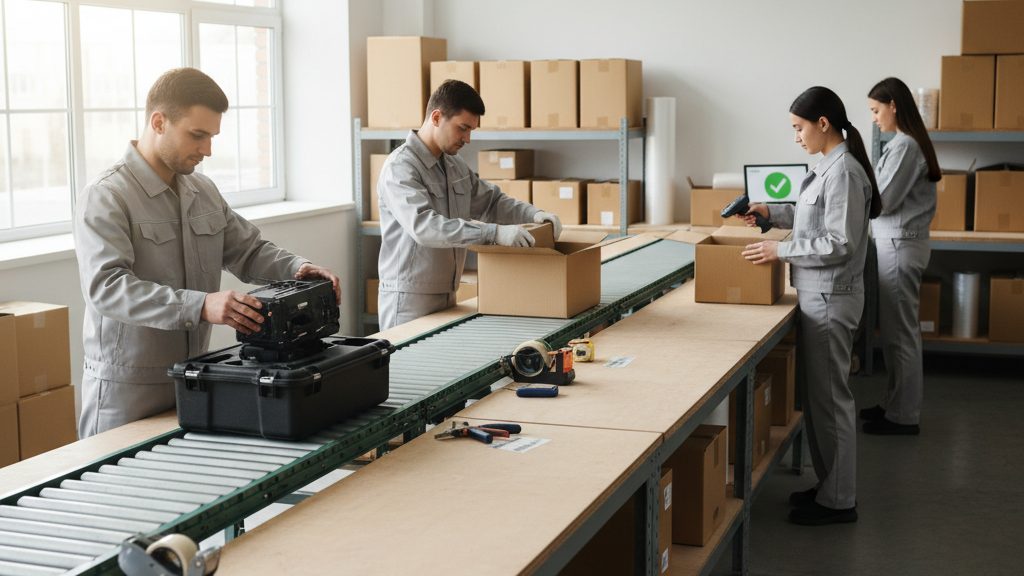
Fulfilment runs in five steps: inbound receipt and check, putaway into storage, picking against each order, packing with the right protection, and dispatch with a carrier. Good fulfilment keeps stock accurate at every one of them, so what the system says is on the shelf is actually on the shelf.
- Receive and check inbound stock against the delivery and the purchase order
- Put it away in secure storage with real time inventory records
- Pick the items for each order
- Pack with protection suited to the product
- Dispatch and track through to the customer
The step that decides whether the other four work is the first one. If inbound is checked properly, discrepancies surface while the supplier can still be held to them. If it is waved through, the error hides in the stock file and only appears when a picker cannot find the unit an order needs.
Why is fulfilment different for technical goods?
Technical and high-value goods need more than a box and tape. Sensitive equipment needs protective packing, accurate serial and batch tracking and secure handling so nothing is damaged or lost. A generalist operation built for light parcels often struggles with items that are heavy, fragile or expensive, because its whole process is tuned for speed per parcel rather than care per unit.
The cost of an error is different too. A mis-picked consumer item is a return and a small refund. A mis-picked piece of equipment can stop an installation, and the replacement is not a next-day parcel but a lead time. That asymmetry is why technical fulfilment is worth doing slowly and correctly rather than quickly and approximately.
What packing do technical and high-value goods need?
Packing for technical goods is chosen from the risk the item actually faces, not from a standard carton size. The questions are what could break it, what could scratch it, what it weighs, and how many times it will be handled between the shelf and the customer.
- Foam, moulded or cushioned packing for shock-sensitive instruments
- Protection against moisture and dust for goods that will be stored on arrival
- Packing that survives repeated handling, not just one clean journey
- Palletising and strapping for heavy items rather than single-parcel carriage
- Documentation packed with the goods where the receiving site needs it
Packing also has to suit the destination. Equipment going to a live construction or fit-out site meets more handling and more dust than the same unit going to an office reception, and the packing should reflect that.
How is B2B fulfilment different from consumer fulfilment?
B2B fulfilment is fewer orders of higher value, and the receiving end is a business with its own rules. Delivery windows, booking-in procedures, pallet specifications, labelling requirements and paperwork all come from the customer rather than from the carrier, and getting one of them wrong can mean a rejected delivery even when the goods are perfect.
Consumer fulfilment optimises for speed and volume. B2B fulfilment optimises for arriving exactly the way the receiver has asked. For technical goods, most orders are B2B, which is why the process has to be able to bend to the customer’s requirements rather than run one fixed template.
Should you outsource fulfilment?
Outsourcing fulfilment makes sense when order volumes are growing, when storage and packing are taking time away from your core business, or when you want to ship across Europe without running your own warehouse. A fulfilment partner absorbs the peaks, holds the stock and dispatches on your behalf, so you pay for capacity you use rather than carrying it as fixed overhead.
It makes less sense when volumes are small and stable and you already have the space, or when the handling is so specific to your product that teaching it to anyone else costs more than doing it yourself. The honest test is whether logistics is a thing you are good at or a thing that is quietly eating your week.
How does WMG handle fulfilment across Europe?
WMG Technical Logistics runs fulfilment alongside warehousing, customs and European transport under one roof. Stock is stored securely, picked and packed with the right protection, and dispatched across Europe. Because storage, fulfilment and delivery sit in the same operation, there are fewer handovers and one team accountable for every order.
The operation runs from Vlaardingen in the Netherlands and delivers across Europe, so the base is where the work happens rather than the limit of where orders can go. WMG Technical Logistics is one of the seven companies in World Wide Mobility Group and works with data centers and IT, retail and commercial, corporate and office, hospitality and hotels, and fashion.
Frequently asked questions
What is the difference between warehousing and fulfilment?
Warehousing is storing goods. Fulfilment is the active work of picking, packing and dispatching orders out of that stored stock. They work best in one location, because every move between sites adds cost and risk.
Can you ship across Europe?
Yes. Fulfilment connects to our European road transport, so orders are picked, packed and delivered across the continent from one location.
Do you track stock in real time?
Yes. Real time inventory sits behind every order, so stock levels stay reliable and orders ship complete rather than partial.
Can you handle fragile or high-value items?
Yes. We pack with protection chosen for the product and track serials and batches, which is what technical and high-value goods need.
Can you meet a customer’s own delivery and labelling requirements?
Yes. B2B receivers often set their own booking-in windows, pallet specifications and labelling. Those requirements are built into how the order is packed and dispatched rather than handled as an exception.
What happens if inbound stock does not match the delivery note?
The discrepancy is recorded at receipt and raised before the goods are put away, so it can be settled with the supplier rather than turning into a shortage that only appears when an order is picked.
Related: Fulfilment and E-Fulfilment, Warehousing and Storage, Value Added Logistics, Warehousing for high-value and technical goods, 3PL versus in-house logistics.